

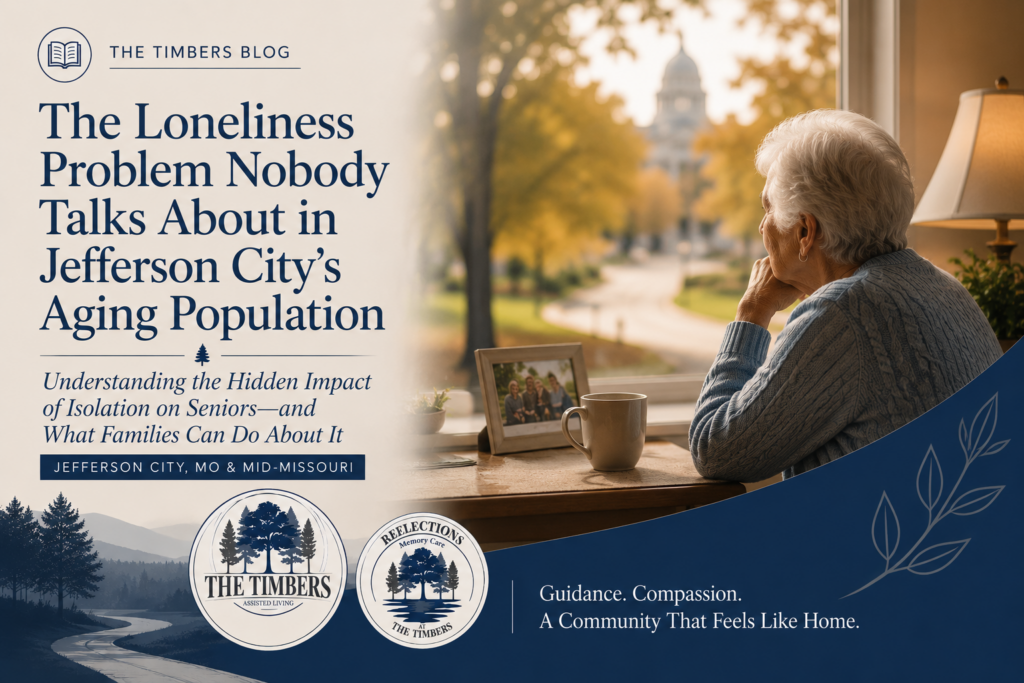
The Loneliness Problem Nobody Talks About in Jefferson City’s Aging Population
When most people think about health risks for older adults, they usually think about heart disease, falls, or memory loss. Very few think about loneliness.
Yet researchers increasingly identify social isolation as one of the most significant threats to healthy aging. Some studies suggest that chronic loneliness can affect physical and mental health as much as many of the risks families traditionally worry about.
The challenge is that loneliness rarely looks the way people expect. It does not always mean someone is visibly unhappy or spending every day alone. In many cases, an older adult appears to be doing relatively well. They still live independently, attend family gatherings occasionally, and insist they are doing fine.
However, their world may be gradually getting smaller.
For families throughout Jefferson City, Holts Summit, and the surrounding Mid Missouri region, this often happens so slowly that it goes unnoticed for months or even years. What begins as a few small changes in routine can eventually become a pattern of isolation that affects overall health, confidence, and quality of life.
The Shrinking World Many Seniors Experience
Families often describe a similar progression.
An aging parent may first stop driving at night because it feels uncomfortable. Later, they begin avoiding longer trips altogether. Invitations to lunch, church, or community events become easier to decline. Over time, activities that once filled their week start disappearing from the calendar.
Nothing dramatic happens overnight. Instead, daily life gradually becomes more limited.
Researchers have found that social engagement plays an important role in maintaining emotional wellbeing, cognitive health, and physical activity levels. When opportunities for meaningful interaction decrease, other challenges often follow. Seniors may become less active, less motivated, and less connected to the people and activities that once gave structure to their lives.
Why Isolation Can Be More Challenging in Mid Missouri
Geography often plays a larger role than families realize.
Throughout Mid Missouri, many adult children live in different communities than their parents. Someone may work in Columbia while their parent lives in Jefferson City. Others may be balancing responsibilities across Fulton, Holts Summit, Linn, or Lake of the Ozarks.
As schedules become busier, regular visits become harder to maintain. What begins as checking in every few days can gradually become checking in every few weeks.
Seasonal weather can make matters worse. Winter conditions often limit travel, outdoor activity, and community participation at a time when social connection becomes especially important. For older adults living alone, these factors can contribute to longer periods of isolation that may not be immediately obvious to family members.
What Families Usually Notice First
The first signs of isolation are often subtle. An aging parent may stop mentioning friends they used to see regularly. Their calendar becomes noticeably emptier. Hobbies that once brought enjoyment begin to fade into the background. Conversations become shorter, and they seem less interested in making future plans.
Because these changes happen gradually, families often assume they are simply part of getting older. In reality, they can signal that an older adult is becoming increasingly disconnected from the people, places, and activities that once kept them engaged.
Over time, that loss of connection can affect confidence as much as it affects emotional wellbeing.
The Connection Between Loneliness and Cognitive Health
Researchers continue to study the relationship between social isolation and cognitive decline, and the findings are difficult to ignore.
Social interaction challenges the brain in ways many people never consider. Conversations require memory, attention, and emotional engagement. Community involvement creates routine and structure. Friendships encourage activity and participation.
When those opportunities decrease, cognitive stimulation often decreases as well.
This does not mean loneliness causes dementia. However, experts increasingly recognize that social engagement is an important component of healthy aging. For families already concerned about memory changes, isolation is often an important factor worth paying attention to.
Why Independence and Connection Are Not Opposites
One of the biggest misconceptions families have about assisted living is that moving into a community means losing independence.
In reality, many seniors experience the opposite.
When daily responsibilities become overwhelming, older adults often begin withdrawing from activities and relationships simply because participation becomes more difficult. Transportation challenges, health concerns, and household responsibilities can all create barriers to staying engaged.
Within a supportive community, those barriers are often reduced.
Meals become opportunities for conversation. Activities become more accessible. Social interaction becomes part of everyday life rather than something that requires significant planning or effort.
Families are often surprised to see a parent become more engaged, more active, and more connected after making a move they initially resisted.
A Question More Families Should Be Asking
When evaluating how an aging parent is doing, most families focus on practical concerns.
Are they taking medications correctly?
Are they paying bills on time?
Are they staying safe at home?
These are important questions.
However, there is another question that deserves equal attention.
Who are they spending time with?
A parent can be physically safe while still struggling with isolation, loneliness, and a declining quality of life. Those challenges are often much harder to see, but they can have a meaningful impact on overall wellbeing.
For Families in Jefferson City Thinking About the Future
If you have noticed an aging parent becoming more isolated, less engaged, or increasingly disconnected from the activities and relationships that once mattered to them, it may be worth paying closer attention.
These changes are often dismissed as a normal part of aging. Many times, they are not.
Families throughout Jefferson City, Holts Summit, Columbia, Fulton, and surrounding Mid Missouri communities are beginning to recognize that quality of life involves more than safety alone.
Connection matters.
Purpose matters.
Community matters.
And sometimes addressing isolation early can make a meaningful difference in an older adult’s overall health, happiness, and independence.
If you are beginning to explore options for an aging parent, the team at The Timbers is always available to answer questions, provide guidance, and help your family understand what support might look like before a crisis forces a decision.